Sep 29, 2026Sourcing Guide
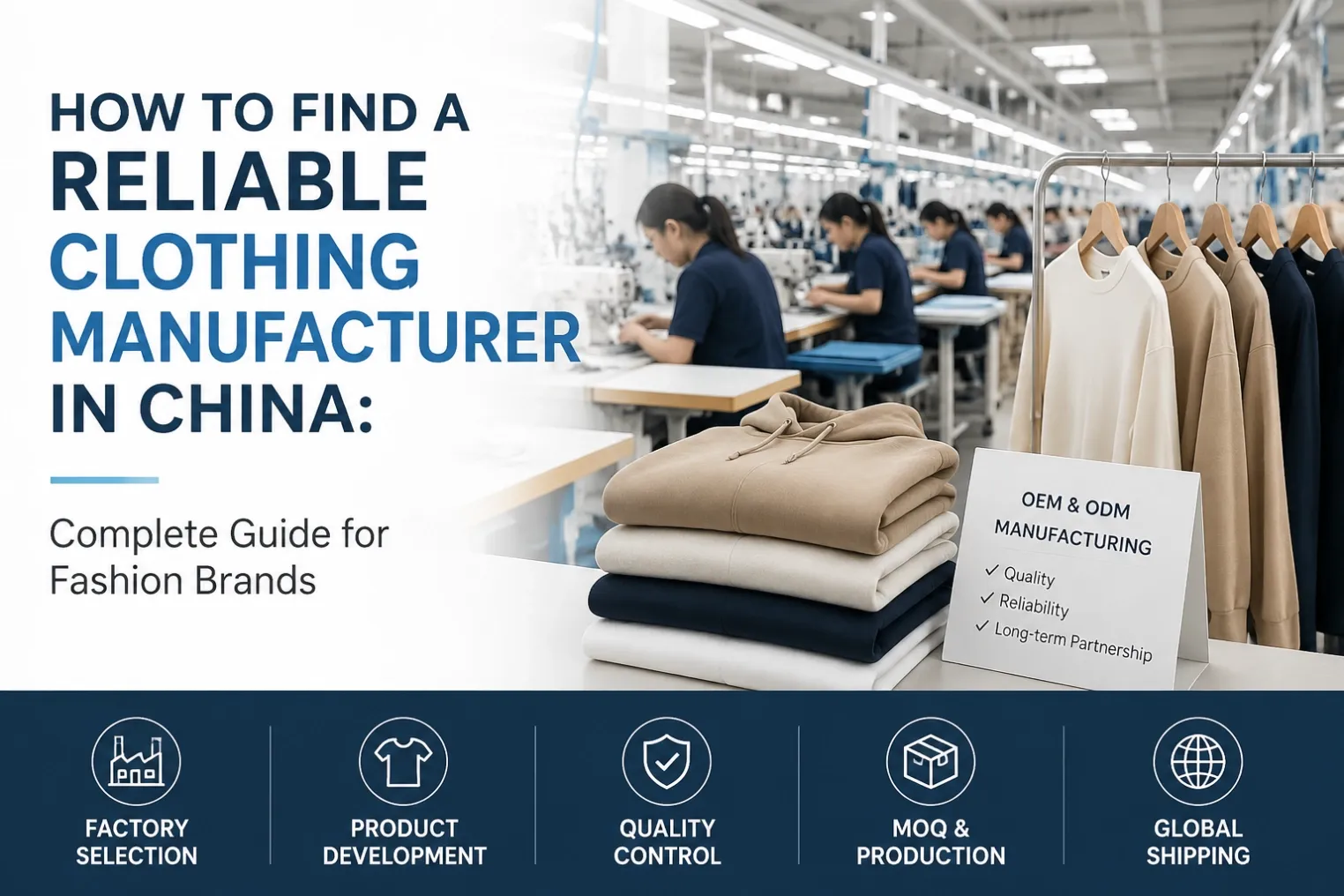
How to Find a Reliable Clothing Manufacturer in China: Complete Guide for Fashion Brands
A practical guide for brand buyers on choosing the right clothing manufacturer in China — from defining your product to comparing quotes and controlling first-order risk.
Start with Your Product, Not with a Factory List
Finding a clothing manufacturer in China is not difficult. Searching online returns hundreds of results. The hard part is knowing which one can actually produce your product — and how to start working with them without wasting money on the wrong factory.
This guide is written for brand owners and buyers who already have a product to develop. If you have not yet verified whether a supplier is a real factory or a trading company, start with our verification checklist and factory vs trading company guide first. This article assumes you have shortlisted real manufacturers and need to choose one.
Before contacting any factory, write down what you are actually making. A manufacturer cannot tell you whether they fit your project if you only say "I need hoodies."
At minimum, prepare:
- Product type (hoodie, leggings, pajama set, hijab, etc.)
- Reference images or a physical sample
- Fabric requirement (composition, GSM, stretch)
- Target quantity per style and per color
- Size range
- Color quantity
- Customization needed (logo, labels, packaging)
- Target market (this affects sizing and compliance)
You do not need a complete tech pack. A clear reference image and basic quantities are enough for an initial review. But "I want good quality activewear, what's your MOQ?" is not enough information for any factory to answer honestly.
Check Whether the Factory Fits Your Product
A real factory is not automatically the right factory. A workshop that produces 300-piece hoodie runs may not own seamless knitting machines. A seamless specialist may not handle woven labels or complex cut-and-sew construction.
Before requesting a quote, confirm:
- What product categories the factory primarily manufactures
- Whether they own the relevant machines (cutting, sewing, knitting, finishing)
- Whether they have worked with your fabric type and GSM range
- Whether they have produced similar garment structures
- Whether their MOQ matches your order plan
- Whether their sampling process can handle your customization level
Ask directly: "Have you produced [your product type] in [your fabric] at [your quantity]?" A factory that fits your project will answer specifically. A factory that does not will redirect you to their catalog.
Pay Attention to the Questions the Factory Asks You
This is the most reliable signal in early communication. A responsible manufacturer should ask about:
- Fabric composition and GSM
- Measurement spec or size chart
- Construction details (seams, stitching, rib type)
- Quantity per style and per color
- Color names and Pantone references
- Logo method and placement
- Packaging requirements
- Delivery expectations
If a supplier quotes a price without asking any of these questions, the quote is based on assumptions that will change later. Good questions are not obstacles. They reduce errors before production starts.
Compare Quotations on the Same Basis
Two quotes for "the same hoodie" can differ by 30% because they include different things. Before comparing prices, confirm that each quote specifies:
- Fabric composition and GSM
- Trim quality (zippers, drawcords, labels)
- Print or embroidery method
- Sampling cost and whether it is refunded
- MOQ per style and per color
- Incoterms (EXW, FOB, DDP)
- Payment terms
- Packaging included
If one quote includes custom packaging and DDP shipping while another only covers EXW ex-factory, the prices are not comparable. Ask each supplier to confirm what is included.
Use the Sample to Test the Working Relationship
The sample stage tells you more about a factory than any conversation. Beyond checking the garment itself — fit, measurements, fabric hand feel, stitching, logo placement — pay attention to how the factory handles the process:
- Did they confirm the spec before starting?
- Were modifications made accurately?
- Did they flag potential issues before production, or after?
- Do they document what was changed and what was approved?
- Do they tell you when something cannot be done as requested?
A factory that communicates clearly during sampling will communicate clearly during bulk. A factory that goes quiet or makes unrequested substitutions during sampling will be worse during production.
Do not approve a sample because it "looks close enough." Tell the factory exactly what is approved and what must be revised. Ambiguity at this stage becomes disputes at bulk.
Control Risk Before the First Bulk Order
For a first order with a new manufacturer, the following sequence reduces risk:
- Approve the sample and document any revisions
- Confirm the final production spec in writing (fabric, measurements, colors, sizes, labels, packaging)
- Confirm a pre-production sample if the design is complex or the fabric has changed since the first sample
- Agree on payment terms — T/T with 30% deposit and 70% balance before shipment is standard
- Request QC photos of the actual bulk goods before shipment
- Start with a quantity you can afford to test — not your full season plan
If the factory resists written specs or delays confirming details, that is a signal to slow down.
Know What a Reliable Manufacturer Should Tell You Honestly
A reliable manufacturer should not say yes to everything. We tell buyers when a design detail does not suit the available machine or construction method, when a fabric has a minimum order quantity that affects their target price, when a customization level requires a higher MOQ than they planned, or when a delivery timeline is not realistic for their quantity and complexity.
These conversations reduce misunderstandings and rework. A supplier who agrees to everything without reviewing your spec is either not reading it, or is planning to adjust after your deposit.
What to Send Us for an Initial Review
If you are developing knitwear, seamless activewear, loungewear, or hijab products, send us your product photos, sketches, or reference sample; tech pack if available; fabric requirement; estimated quantity per style and color; size range; logo and label requirements; and target delivery window.
If some details are not decided yet, send what you have. We can review whether the project fits our production capability and suggest the next step — before you commit to sampling.
Browse Our Apparel Catalogs
You can also browse all SML INTIMATE apparel catalogs to keep exploring styles across our product series.