Jun 26, 2026Industry Insights
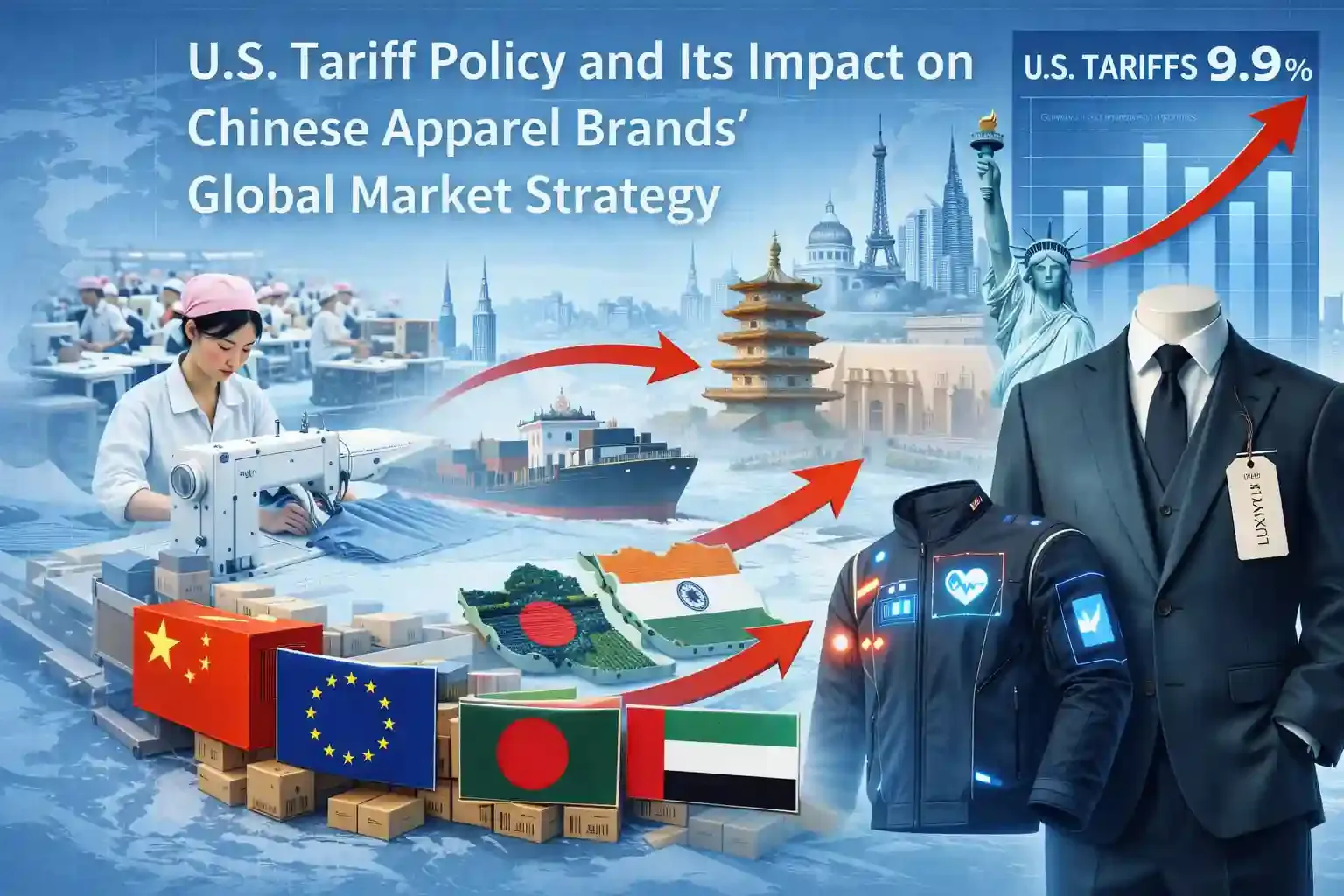
U.S. Tariff Policy and Its Impact on Chinese Apparel Brands’ Global Market Strategy
U.S. tariffs push Chinese apparel brands to diversify into Europe, Southeast Asia, and the Middle East, focusing on innovation, sustainability, and higher-value products.
Author & Source
Author: Connor Ma, International Trade Analyst with 10+ years of experience in global apparel exports and supply chain strategy
Reviewed by: SML Intimate Sourcing Team
Published by: SML Intimate Research Department
Introduction
Since 2018, U.S. tariff policies on Chinese imports have significantly reshaped global trade dynamics. In the apparel sector, average tariffs of approximately 9–10% have placed sustained pressure on pricing, margins, and sourcing strategies.
Based on export experience and B2B market observations, Chinese apparel brands are no longer relying heavily on the U.S. market. Instead, they are actively diversifying into regions such as Europe, Southeast Asia, and the Middle East, where trade conditions, growth potential, and competitive dynamics differ significantly.
1. Market Diversification Beyond the U.S.
1.1 Europe: Stable Demand and Regulatory-Driven Upgrading
Europe has become a primary alternative market for Chinese apparel exporters.
Key drivers include:
- Relatively moderate tariff structures compared to the U.S.
- Strong and stable consumer demand
- Increasing emphasis on sustainability and compliance
Major markets such as Germany, France, and United Kingdom are seeing steady growth in imports of Chinese apparel.
At the same time, stricter EU regulations on sustainability are pushing manufacturers to upgrade:
- Eco-friendly materials
- Transparent supply chains
- Compliance with environmental standards
👉 This is accelerating the transition from low-cost production to value-added manufacturing.
1.2 Southeast Asia: Strategic Growth and Regional Integration
Southeast Asia is emerging as both a production base and a consumer market.
Countries such as Vietnam, Thailand, and Indonesia benefit from:
- Regional trade agreements such as RCEP
- Lower tariff barriers
- Rapidly growing middle-class populations
In addition to production relocation, Chinese brands are increasingly:
- Expanding regional distribution networks
- Establishing local partnerships
- Targeting fast-growing domestic consumption
👉 Southeast Asia is no longer just a manufacturing hub—it is becoming a key demand market.
1.3 Middle East: High-Margin Emerging Markets
Middle East offers strong growth potential, particularly in premium and mid-range apparel segments.
Key markets include:
- United Arab Emirates
- Saudi Arabia
- Qatar
These markets are characterized by:
- High purchasing power
- Demand for “affordable luxury”
- Strong retail and distribution channels
Chinese brands are leveraging:
- Local partnerships
- Participation in regional fashion events
- Expansion of retail presence
👉 Result: higher margins and improved brand visibility
2. Value-Driven Differentiation Strategies
As tariffs increase cost pressure, Chinese apparel brands are shifting from price competition to value-based competition.
2.1 Sustainability and Compliance
Sustainability has become a key differentiator, especially in European markets.
Manufacturers are investing in:
- Recycled and organic fabrics
- Water-saving dyeing technologies
- Ethical production processes
This not only improves compliance but also allows brands to:
- Access premium markets
- Strengthen brand positioning
- Meet buyer sourcing requirements
2.2 Technological Innovation and Smart Apparel
Innovation is another major growth driver.
Chinese brands are increasingly developing:
- Functional fabrics (moisture-wicking, anti-bacterial)
- Temperature-regulating garments
- Smart apparel with embedded technology
The global wearable fashion segment continues to grow, creating opportunities for:
👉 higher pricing power and product differentiation
2.3 Premiumization and Brand Building
To reduce reliance on low-margin segments, many Chinese brands are moving into mid-to-high-end markets.
Key strategies include:
- Improved fabric quality and garment construction
- Limited collections and design differentiation
- Stronger brand identity and storytelling
This reflects a broader shift:
👉 from OEM manufacturing → branded value creation
3. Evolving Global Competitive Landscape
3.1 Multi-Country Production Strategy
To mitigate tariff risks, many Chinese companies are adopting a “China + 1” or multi-country sourcing model, including production in:
- Vietnam
- Indonesia
- Mexico
This strategy helps:
- Reduce tariff exposure
- Maintain cost competitiveness
- Increase supply chain flexibility
3.2 Direct-to-Consumer (DTC) Expansion
The rise of e-commerce has enabled Chinese brands to expand globally through direct-to-consumer (DTC) models.
Advantages include:
- Greater control over branding
- Higher margins
- Reduced reliance on traditional retail channels
This is particularly effective in:
- Europe
- Southeast Asia
- Emerging digital markets
Conclusion
U.S. tariff policies have accelerated a fundamental transformation in the global apparel industry.
Chinese apparel brands are responding by:
- Diversifying into new markets
- Investing in sustainability and innovation
- Moving up the value chain
- Adopting flexible supply chain strategies
In the evolving global trade environment, success is no longer defined by cost alone. Instead, it depends on a company’s ability to adapt, differentiate, and build long-term value across multiple markets.
References
- Office of the United States Trade Representative (USTR). Section 301 Tariff Reports
- China National Textile and Apparel Council (CNTAC). Industry Export Data 2025
- McKinsey & Company. The State of Fashion 2024–2025
- Euromonitor International. Global Apparel Market Outlook 2025
- World Bank. Global Trade and Emerging Market Growth Data