Jun 26, 2026Industry Insights
How Free Trade Agreements Can Help Chinese Apparel Exporters Respond to Rising U.S. Tariffs
How Chinese apparel exporters use free trade agreements like RCEP to reduce tariffs, diversify markets, and offset the impact of U.S. trade barriers.
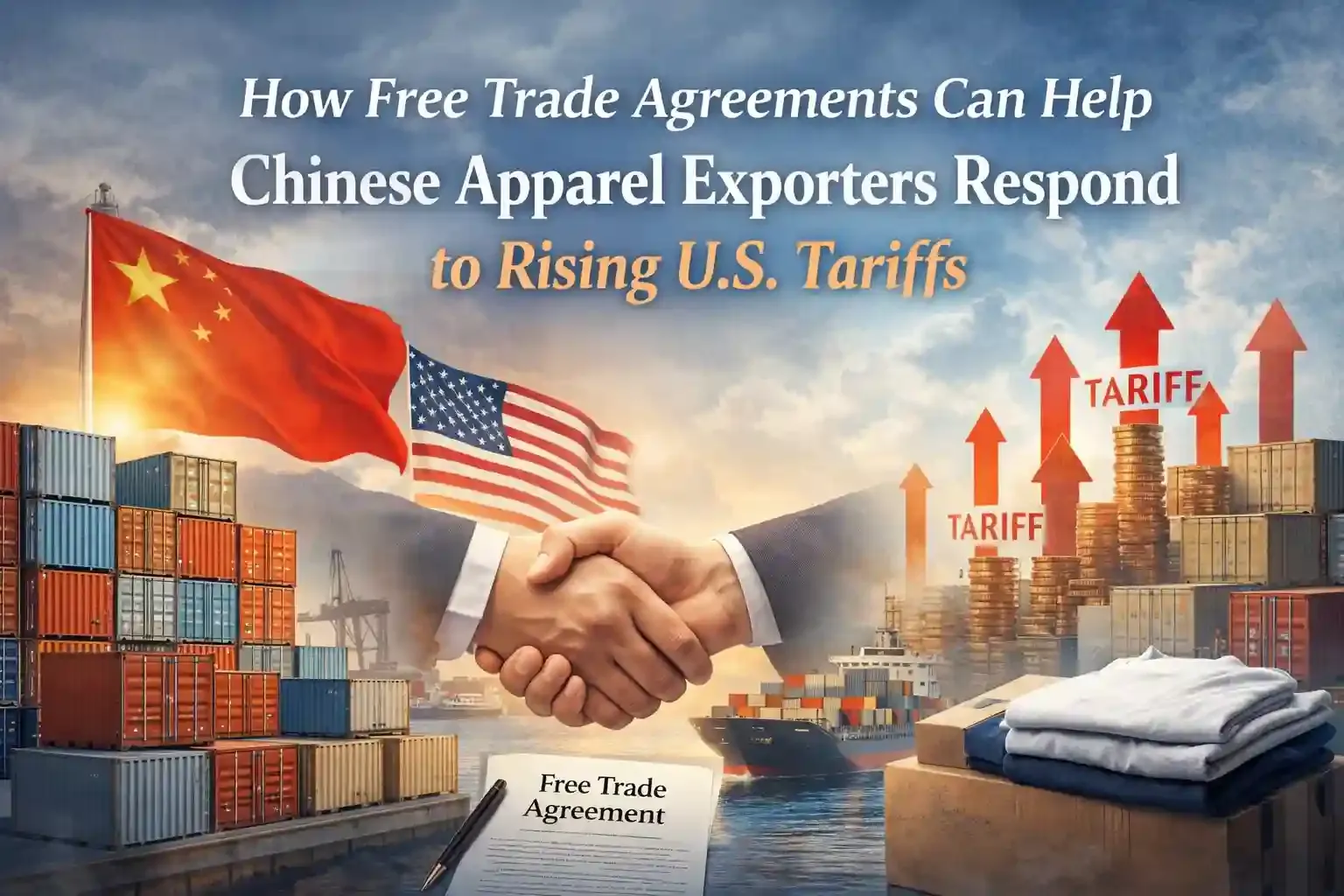
In recent years, rising U.S. tariffs on Chinese goods have significantly reshaped global apparel trade patterns. As tariffs increase costs and reduce competitiveness in the U.S. market, Chinese apparel exporters are increasingly turning to free trade agreements (FTAs) as a strategic tool to reduce tariff burdens, diversify markets, and maintain global competitiveness.
By leveraging existing trade agreements and exploring new markets with preferential tariff policies, Chinese clothing manufacturers can mitigate the impact of trade barriers while expanding their global reach.
Free Trade Agreements That Can Reduce Tariff Pressure
China has built one of the world’s largest networks of free trade agreements. These agreements provide preferential tariff treatment, making it easier for Chinese apparel exporters to access foreign markets.
The Regional Comprehensive Economic Partnership (RCEP)
One of the most important trade agreements for Chinese apparel exporters is the Regional Comprehensive Economic Partnership (RCEP), which came into force in 2022 and includes 15 countries across Asia-Pacific, such as China, Japan, South Korea, Australia, New Zealand, and the 10 ASEAN members.
Under the RCEP framework, tariff reductions are substantial. More than 94% of textile and apparel products traded among member countries will eventually reach zero tariffs, significantly lowering trade costs for exporters.
The agreement is already producing measurable results. By November 2025, customs authorities in Zhejiang alone had issued 295,000 RCEP certificates of origin, covering exports worth 80.69 billion yuan (about $11.5 billion) and allowing companies to claim tariff reductions in partner markets.
For apparel exporters, RCEP also introduces simplified rules of origin, which allow materials sourced from multiple member countries to qualify for tariff preferences. This flexibility helps companies build regional supply chains and reduce overall production costs.
China-ASEAN Free Trade Area
The China-ASEAN Free Trade Area is another key agreement supporting apparel exports. ASEAN countries such as Vietnam, Thailand, and Indonesia are important manufacturing and consumer markets for textiles and garments.
Under preferential tariff schedules, many textile and apparel products traded between China and ASEAN members already enjoy low or zero import duties, helping exporters remain competitive in Southeast Asian markets.
In addition, ASEAN economies are among the fastest-growing consumer markets in the world. Rising middle-class populations in countries like Indonesia and Vietnam are driving increased demand for apparel and fashion products.
Other Bilateral Trade Agreements
China also maintains free trade agreements with countries including:
- Australia
- New Zealand
- Chile
- Switzerland
- South Korea
These agreements reduce tariff barriers and create opportunities for Chinese apparel companies to enter new markets where trade conditions are more favorable.
How Exporters Can Utilize FTAs to Reduce Tariff Costs
Although FTAs offer significant benefits, companies must actively manage trade compliance and documentation to fully benefit from tariff reductions.
Obtaining Certificates of Origin
One of the most important steps is applying for a certificate of origin, which proves that exported products meet the requirements of the trade agreement.
Without this certification, exporters cannot claim preferential tariff treatment, even if the goods qualify under the agreement.
As more companies adopt these practices, the number of firms using RCEP certification continues to grow, with thousands of companies now benefiting from lower tariffs in partner markets.
Optimizing Regional Supply Chains
Another strategy involves restructuring supply chains to meet rules of origin requirements.
For example, companies may source fabrics or accessories from other RCEP member countries while completing final garment production in China. This approach allows the final product to qualify for preferential tariff treatment when exported within the region.
By integrating production across multiple countries, apparel exporters can both reduce tariffs and improve supply chain resilience.
Accelerating Market Diversification Through Trade Agreements
Free trade agreements also play an important role in helping Chinese apparel exporters diversify away from the U.S. market.
Trade tensions and tariffs have already shifted export flows. In the first half of 2025, Chinese textile exports to the European Union increased by 20%, as companies redirected shipments previously destined for the United States.
By leveraging trade agreements with multiple regions, Chinese exporters can:
- reduce dependence on a single market
- expand into emerging economies
- stabilize long-term export growth
Diversification also helps companies manage risks related to geopolitical tensions and trade policy uncertainty.
Conclusion
As U.S. tariffs continue to reshape global trade dynamics, free trade agreements have become a critical strategic tool for Chinese apparel exporters. Agreements such as RCEP and various bilateral FTAs provide preferential tariff treatment, simplified trade procedures, and access to rapidly growing markets.
By actively utilizing these agreements, optimizing supply chains, and expanding into new regions, Chinese apparel manufacturers can mitigate tariff risks while maintaining strong positions in the global fashion industry.
In the coming years, the effective use of trade agreements will likely become one of the most important competitive advantages for apparel exporters navigating an increasingly complex global trade environment.